Every year, hundreds of workers suffer life-altering injuries during servicing or maintenance because machines were accidentally energized. The root cause? Missing, outdated, or improperly followed lockout tagout (LOTO) written procedures. A written LOTO procedure isn't just paperwork—it's a legally required, step-by-step defense against electrocution, amputation, and crushing injuries. When done right, it codifies safety. When neglected, it becomes a liability magnet.
This guide breaks down exactly what a lockout tagout written procedure must include, how to write one that workers will actually follow, and why generic templates often fail in real-world environments.
What Is a Lockout Tagout Written Procedure?
A lockout tagout written procedure is a formal, documented set of instructions that details how to isolate hazardous energy sources and secure machines or equipment before maintenance or servicing begins. It's more than labeling a switch—it’s a sequence of validated actions that protect workers from unexpected startup or energy release.
Under OSHA 29 CFR 1910.147, any facility using machinery with hazardous energy (electrical, mechanical, hydraulic, pneumatic, chemical, thermal, etc.) must have written procedures. These documents serve three primary functions:
- Standardization: Ensures every worker performs LOTO the same safe way.
- Training Aid: Used to teach new employees proper energy isolation.
- Audit Trail: Provides proof of compliance during inspections.
Without a written procedure, even a well-intentioned LOTO attempt can fail due to miscommunication, memory lapses, or incomplete shutdowns.
Key Components of an Effective LOTO Written Procedure
A strong procedure isn't a paragraph slapped on a clipboard. It's a structured, unambiguous guide. Every certified LOTO written procedure should include these six non-negotiable elements:
1. Machine or Equipment Identification Clearly name and identify the equipment. Include serial numbers, model details, and physical location if multiple units exist. Example: > Equipment: Conveyor System – Line 3, Model XTR-2200, located in Packaging Zone B.
2. Energy Source Inventory List every type and point of hazardous energy. Don't assume. Walk the machine and document:
| Energy Type | Isolation Point | Device Type |
|---|---|---|
| Electrical | Main disconnect breaker | Circuit lockout |
| Mechanical | Drive chain | Physical barrier |
| Pneumatic | Air supply valve | Ball valve with padlock |
| Hydraulic | Pressure line shutoff | Lockable valve |
This inventory becomes the basis for isolation steps.
3. Shutdown Sequence Detail the exact steps to safely shut down the machine before isolation begins. This includes:
- Notifying affected operators
- Bringing the machine to a complete stop
- Disengaging automated controls
- Powering down control circuits
Example: > 1. Press "Emergency Stop" on control panel. > 2. Rotate mode selector to "Off." > 3. Confirm all moving parts have stopped for at least 30 seconds.
4. Isolation and Lockout Steps
This is the core. List each energy isolating device and how to secure it:
1. Locate main electrical disconnect for Line 3 conveyor. 2. Flip switch to "Off" position. 3. Apply personal lockout device (LOTO hasp + employee-specific padlock). 4. Tag device with employee name, date, time, and reason.
Repeat for every energy source. If there are 5 isolating points, there should be 5 documented actions.
5. Verification of Zero Energy No LOTO is complete until energy is verified as absent. The procedure must require:
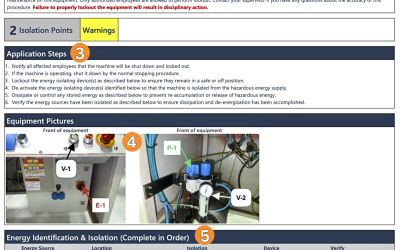
- Testing controls (e.g., pressing start button)
- Using voltage testers, pressure gauges, or other tools
- Confirming no residual or stored energy remains
Verification Step: Use a CAT III voltage tester to confirm 0V at main disconnect. Attempt to start conveyor via control panel—no response indicates successful isolation.
6. Steps for Restoration Equally important: how to safely return the machine to service. Include:
- Removal of tools and guards replaced
- Notification of all affected employees
- Authorized worker removes their own lock
- Systematic re-energizing in reverse order
Restoration Warning: Only the employee who applied the lock may remove it—unless formal group lockout protocol is followed.
Common Mistakes in Written LOTO Procedures
Even compliant-looking documents fail in practice due to subtle flaws. Watch for these:
❌ Using One Procedure for Multiple Machines A template for "all grinders" or "all presses" ignores unique energy sources. A 5HP bench grinder has different risks than a 50HP industrial press. Each machine needs its own documented procedure.
❌ Vague Language Phrases like "turn off power" or "lock the source" are dangerous. Be specific: "Open circuit breaker QF3 in Panel B2 and apply padlock #L14."
❌ Skipping Stored Energy Springs, capacitors, elevated parts, and hydraulic accumulators can release energy after power is cut. Procedures must address controlled release—like bleeding air lines or blocking suspended loads.
❌ Not Including Group Lockout Steps In team maintenance, a single worker shouldn’t control isolation. Use a group lockout box where each technician applies their lock to a master device. The procedure should map this workflow.
❌ Failure to Review and Update Machines get upgraded. Motors replaced. Piping rerouted. If the LOTO procedure isn't reviewed annually or after modifications, it's obsolete.
Real-World Example: LOTO Procedure for a Hydraulic Press
To illustrate, here’s a condensed version of a real-world written procedure.
Equipment: 200-Ton Hydraulic Press, Model HP-200A, Station 5
Energy Sources: - Electrical (480V main feed) - Hydraulic (oil under 2,500 psi) - Mechanical (flywheel and ram)
- Shutdown:
- Press E-Stop. Wait 60 seconds.
- Rotate control selector to "Off."
- Isolation:
- Open main disconnect (ID: E1) in Electrical Cabinet 5.
- Attach personal lock and tag.
- Close and lock hydraulic supply valve (V-12).
- Open pressure relief valve (RV-3) to bleed system.
- Confirm pressure gauge reads 0 psi.
- Block ram with two steel safety blocks.
Verification: - Test start button—no response. - Confirm zero voltage at E1 with multimeter. - Visually inspect that ram is physically blocked.
- Restoration:
- Remove safety blocks.
- Close relief valve.
- Notify supervisor and coworkers.
- Remove locks and tags.
- Restore hydraulic valve.
- Close main disconnect.
- Return control to "Auto."
This level of detail eliminates guesswork—even under time pressure.
How to Develop a Written LOTO Procedure: A Step-by-Step Workflow
Creating a compliant procedure isn’t a one-day task. Follow this workflow:
Step 1: Conduct an Energy Audit Walk every machine. Identify all energy sources and isolation points. Involve maintenance techs—they know where hidden valves or capacitors live.
Step 2: Draft with Maintenance Input Write the first version using technician input. Use photos or diagrams to clarify isolating devices.
Step 3: Validate with a Dry Run Perform a live test—without servicing—where an employee follows the draft procedure. Note any confusion or missing steps.
Step 4: Finalize and Approve Incorporate feedback. Get sign-off from safety manager and engineering lead.
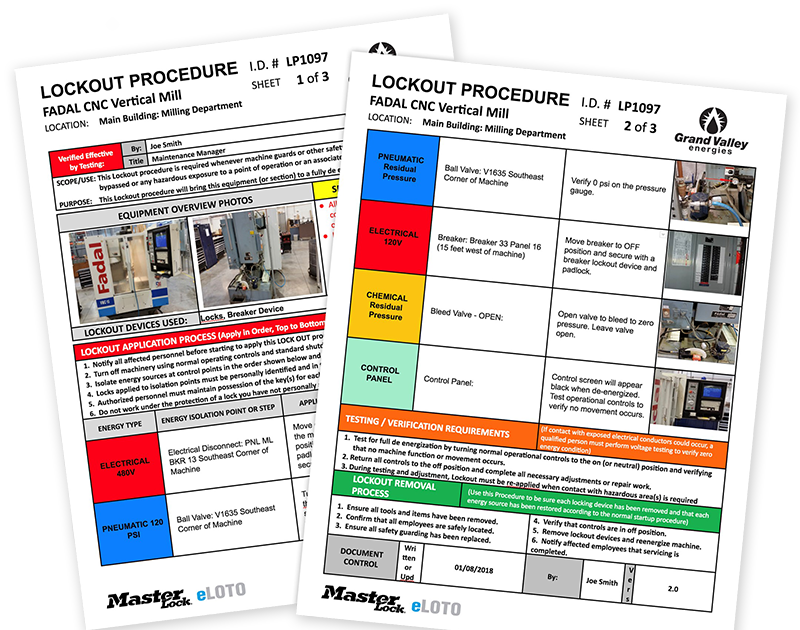
Step 5: Train and Distribute Train all affected and authorized employees. Post copies near equipment or store digitally with quick access.
Step 6: Review Annually Schedule a calendar reminder. Reassess after any incident, near-miss, or equipment change.
Digital vs. Paper-Based LOTO Procedures: What Works Best?
While OSHA doesn’t mandate format, modern facilities are shifting to digital solutions for better control and accessibility.
| Format | Pros | Cons |
|---|---|---|
| Paper Binders | Simple, no tech required | Prone to damage, hard to update, hard to track access |
| PDFs on Intranet | Searchable, printable, version-controlled | Requires network access, no real-time validation |
| LOTO Management Software | Mobile access, audit trails, integration with work orders | Upfront cost, training required |
For high-risk or large-scale operations, digital platforms like LockOut TagOut Pro, iAuditor, or EHS Insight offer checklists, photo verification, and electronic sign-off—reducing human error.
But even a digital system fails if the content of the procedure is weak. Tools support compliance—they don’t replace proper documentation.
Why Most LOTO Programs Fail (and How to Fix It)
Compliance isn’t about having a binder—it’s about consistent execution. Audits reveal that:
- 60% of LOTO violations stem from incomplete procedures
- 30% involve bypassing steps due to production pressure
- 10% are from poor training or language barriers
The fix starts with realistic procedures. Workers skip steps when instructions are unclear or overly complex. Involve frontline staff in writing and reviewing LOTO documents. Use plain language. Add visual aids.
Also, leadership must enforce compliance without exception. A supervisor telling a tech to "just fix it quickly" undermines the entire system.
Build, Test, Sustain: Your LOTO Procedure Action Plan
A lockout tagout written procedure isn't a compliance checkbox—it's a living safety protocol. Start by auditing one high-risk machine. Build a detailed, machine-specific document. Validate it with a real shutdown. Train your team. Then scale.
The cost of a single injury dwarfs the time investment. A well-written LOTO procedure doesn’t just satisfy OSHA—it saves limbs, lives, and operational continuity.
Begin today: pick one machine, walk its energy points, and draft a real, usable procedure. Not tomorrow. Not after the next audit. Now.
FAQ
What must a written LOTO procedure include? It must identify the equipment, list all energy sources, detail shutdown and isolation steps, include verification of zero energy, and outline safe re-energizing procedures.
Do all machines need a separate LOTO procedure? Yes, if they have unique energy sources or isolation points. Similar machines may share a procedure only if they are identical in function and risk.
Who is responsible for writing LOTO procedures? Employers are responsible, but the process should involve safety officers, maintenance supervisors, and authorized employees familiar with the equipment.
How often should LOTO procedures be reviewed? At least annually, and whenever equipment is modified, repaired, or involved in an incident.
Can LOTO procedures be digital? Yes, as long as they are accessible to authorized employees during servicing and meet OSHA’s clarity and completeness requirements.
What happens if a LOTO procedure is not followed? It can lead to catastrophic injury, OSHA fines (up to $15,625 per violation), and legal liability. Non-compliance is never worth the risk.
Can a worker remove someone else’s lock? Only under a formal "authorized removal" process, which requires verification that the original locker is not at risk and has been notified.
FAQ
What should you look for in Lockout Tagout Written Procedure: A Practical Guide to Compliance? Focus on relevance, practical value, and how well the solution matches real user intent.
Is Lockout Tagout Written Procedure: A Practical Guide to Compliance suitable for beginners? That depends on the workflow, but a clear step-by-step approach usually makes it easier to start.
How do you compare options around Lockout Tagout Written Procedure: A Practical Guide to Compliance? Compare features, trust signals, limitations, pricing, and ease of implementation.
What mistakes should you avoid? Avoid generic choices, weak validation, and decisions based only on marketing claims.
What is the next best step? Shortlist the most relevant options, validate them quickly, and refine from real-world results.